Choosing an e-file bit is not only about shape and grit. The material of the bit matters just as much, because it changes how the bit cuts, how it feels in the handpiece, and what type of service it is best suited for.
The three materials professionals ask about most often are diamond, carbide, and ceramic. They are not interchangeable, and using the wrong one for the job usually makes the service harder rather than easier.
If you understand what each material is meant to do, it becomes much easier to build a working set that actually makes sense for your day-to-day services.
Diamond bits are usually the first choice for manicure prep
Diamond bits are the material most nail techs associate with dry manicure and detailed prep work. They are designed to give controlled surface contact rather than aggressive product removal, which is why they are so useful around the cuticle area and sidewalls.
In practical terms, diamond bits are usually chosen for:
- lifting and refining the cuticle area
- cleaning sidewalls
- removing non-living tissue carefully
- preparing the nail before product application
- controlled work on natural nails when the correct grit is used
That is why shapes such as flame, ball, cone, and rounded cone are so often made in diamond. The material gives you precision and control where you need accuracy most.
For example, a Flame E File Nail Drill Bit is a strong all-round prep bit, while a Ball E File Nail Drill Bit Size 3.1mm is ideal for finishing cuticle work neatly after lifting. If you prefer a more controlled detailing shape, a Rounded Cone E File Nail Drill Bit is another very useful diamond option.
Carbide bits are made for removal and bulk reduction
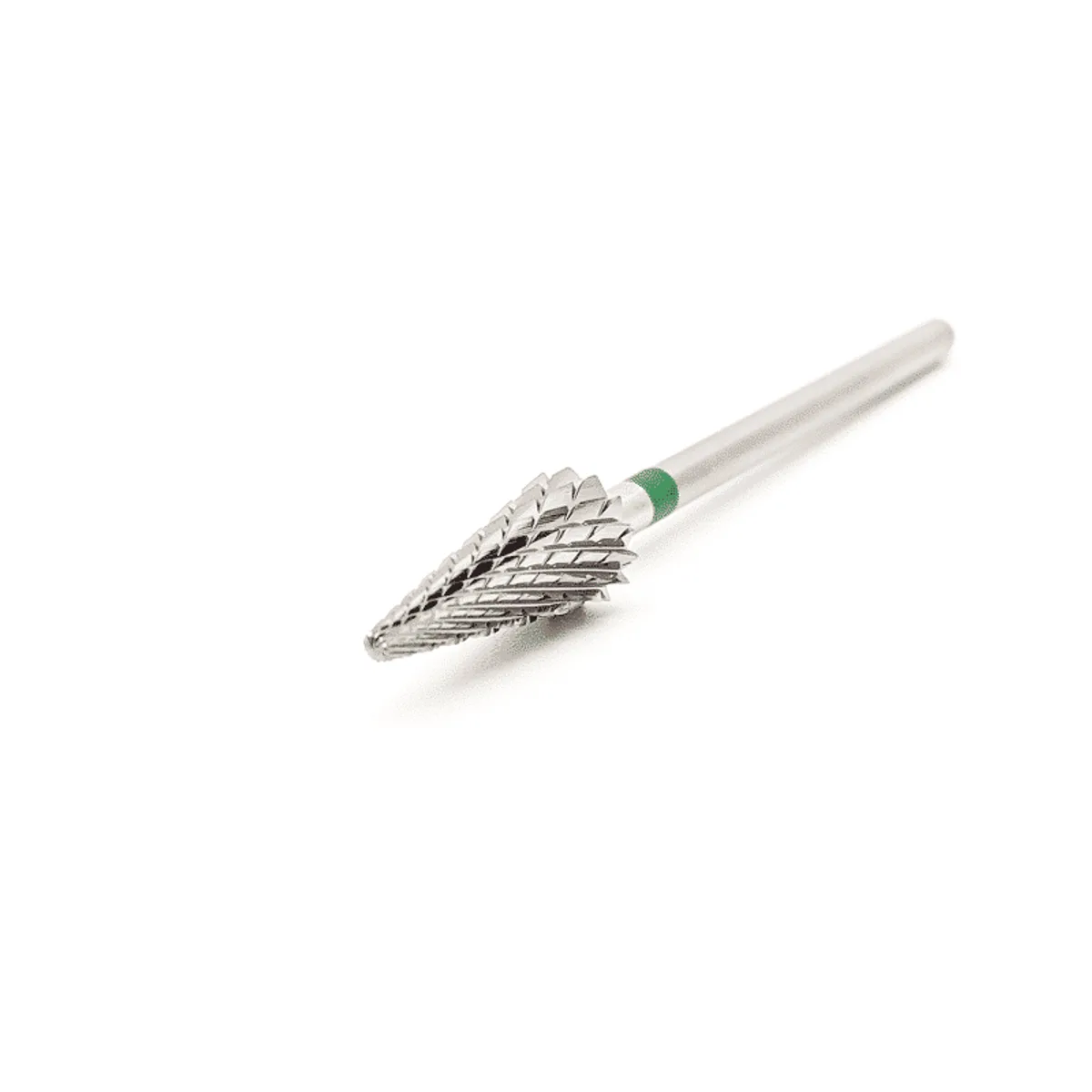
Carbide bits are very different from diamond bits. They are designed to cut through product far more efficiently, which is why they are usually chosen for removal work rather than prep.
If you regularly remove gel, hard gel, acrylic, or polygel, carbide becomes one of the most important materials in your kit.
Carbide bits are commonly used for:
- reducing bulk quickly
- removing gel and acrylic
- refining the surface of enhancements
- shortening product
- rebalancing and infill work
Compared with diamond bits, carbide bits feel more aggressive and more purposeful in removal. They should still be used with control, but they are built for a different stage of the service.
Our Carbide E File Nail Drill is a good example of a general removal bit, while a Barrel Carbide E File Nail Drill Bit gives a broader contact shape that many techs prefer for product reduction.
If your main question is, "What should I use for prep?" the answer is usually diamond. If the question is, "What should I use for removal?" the answer is usually carbide.
Ceramic bits are usually discussed as an alternative removal material
Ceramic bits are most often compared with carbide, not with diamond.
That is because ceramic bits are generally used for product removal and refinement rather than cuticle preparation. Many technicians like ceramic bits because they can feel smoother and sometimes run with a slightly different sensation during removal. Some people also feel ceramic creates a softer cutting feel depending on the bit, speed, and the product being removed.
That said, ceramic is not automatically "better" than carbide. It is simply different.
In real salon work, many professionals still prefer carbide because it is durable, efficient, and very predictable once you know what grit and shape you like. Ceramic can suit some working styles very well, but carbide remains the more common professional choice for heavy and regular removal work.
So the simplest comparison is:
- diamond for prep and detailed manicure work
- carbide for removal and bulk reduction
- ceramic as another removal-focused option, often chosen for feel rather than for prep
Which material is best for natural nails?
If you are working directly on the natural nail or around the cuticle area, diamond is usually the safest and most practical place to start.
That does not mean every diamond bit is automatically safe in every hand. Grit, speed, pressure, and technique still matter. But as a material, diamond is the one most commonly used for controlled prep and manicure work.
Carbide and ceramic are not usually the first recommendation for natural nail prep. They are removal materials first. They can be misused very easily if someone treats them like a prep bit.
If your work is mainly manicure prep, our Blue Flame E File Nail Drill Bit, Cone E File Nail Drill Bit, and Ball E File Nail Drill Bit are much more logical starting points than a removal carbide.
Material does not replace shape
One of the most common mistakes is to talk about material as if it is the only thing that matters. It is not. Shape still changes how the bit behaves.
For example:
- a flame diamond bit is for precise prep around the cuticle zone
- a ball diamond bit is for finishing and removing loose non-living tissue
- a barrel carbide bit is for stable surface removal
- a cone carbide bit may feel more precise during controlled product reduction
So when choosing the right bit, think in layers:
- What is the service stage: prep, removal, or finishing?
- What material suits that task best?
- What shape gives you the control you need?
- What grit is appropriate for the material and service?
That approach is much more useful than trying to ask which one material is "best" overall.
A simple way to choose the right material
If you want a straightforward rule of thumb:
- choose diamond for cuticle work, prep, and controlled manicure detailing
- choose carbide for gel or acrylic removal and bulk reduction
- consider ceramic if you specifically prefer that style of removal feel, but do not treat it as a replacement for prep bits
For many nail techs, a sensible working kit includes both diamond and carbide because they solve different problems. Prep and removal are not the same job, so they should not be done with the same expectation from the bit material.
If you are building a set, you can also look at our Most Essential 20 E File Nail Drill Bits Set For the Manicure And Pedicure to get a broader feel for the shapes used in professional services.
Final thoughts
The best e-file material depends on what you are trying to do.
If your goal is clean, precise manicure prep, diamond is usually the right answer. If your goal is efficient product removal, carbide is usually the better choice. Ceramic sits closer to carbide in function, but is more about preferred feel and working style than replacing diamond prep bits.
In other words, the right choice is not really diamond or carbide or ceramic in isolation. The right choice is the material that matches the service, the stage of the work, and the amount of control you need.
If you want to compare professional options, you can browse our full shop or start with the Flame E File Nail Drill Bit, Ball E File Nail Drill Bit Size 3.1mm, and Carbide E File Nail Drill linked above.