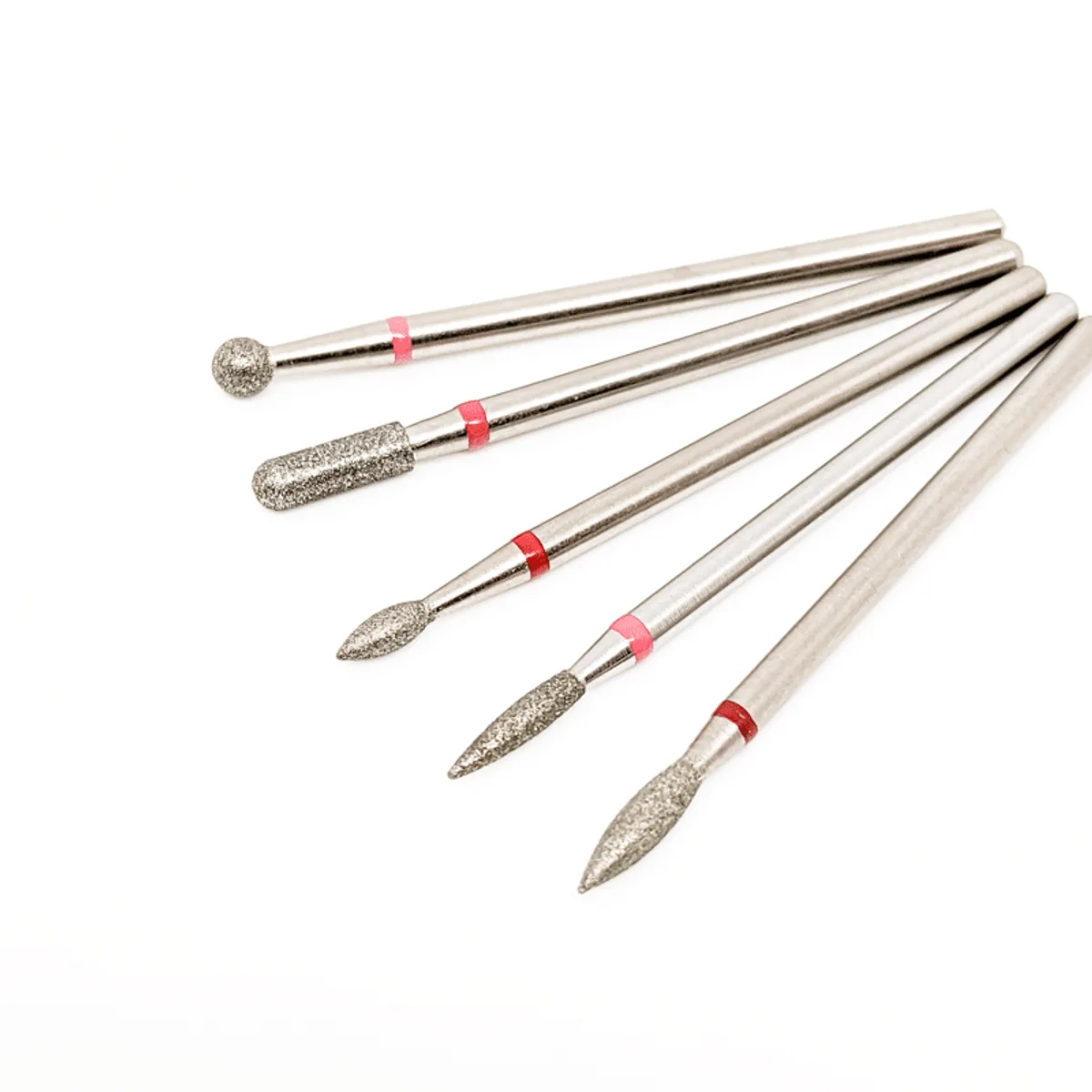
If you are trying to improve your manicure prep, one of the most common questions is whether you need a flame bit, a ball bit, or both. At first glance they can seem like two small prep bits for the same area, but they are not designed to do exactly the same job.
That is why the better question is not really flame bit vs ball bit, which one is better? It is which one do you need for the stage of cuticle work you are doing?
In most professional manicure routines, the answer is that they work best as different tools for different steps.
What does a flame bit do in cuticle work?
A flame bit is usually used for lifting, opening, and refining around the cuticle area and sidewalls.
Its tapered shape helps the bit reach the sinus area more easily and work neatly along the cuticle line without feeling too bulky. This is one reason flame bits are often one of the first shapes nail techs choose for dry manicure prep.
In practical terms, a flame bit is commonly used to:
- gently lift the cuticle area
- clean sidewalls
- create better visibility around the cuticle line
- prepare the area before using another finishing bit
That is why flame bits are often treated as the main prep bit rather than the final finishing bit.
Examples from our range include the Flame E File Nail Drill Bit, the Flame E File Nail Drill Bit Size 1.8mm, and the Blue Flame E File Nail Drill Bit.
What does a ball bit do in cuticle work?
A ball bit is usually used for finishing after the cuticle area has already been lifted and prepared.
Instead of opening the cuticle zone in the way a flame bit does, a ball bit is more commonly used to remove loosened non-living tissue and tidy the area so the final result looks cleaner and more refined.
That means a ball bit is often the next step rather than a replacement for a flame bit.
Ball bits are commonly used to:
- remove loosened non-living cuticle tissue
- refine the cuticle line after lifting
- smooth the finished look around the cuticle area
- tidy preparation work without needing a pointed shape
Examples include the Ball E File Nail Drill Bit Size 3.1mm, the Ball E File Nail Drill Bit Size 1.4mm, and the Ball E File Nail Drill Bit.
Are flame bits and ball bits used for the same step?
Usually, no.
This is the main reason comparing them as if you must choose only one can be misleading. In a lot of manicure workflows, especially dry manicure or Russian manicure prep, the two shapes are used in sequence rather than in competition.
A very common pattern is:
- use a flame bit to lift and refine around the cuticle zone
- use a ball bit to finish and remove loosened tissue neatly
That is why many nail techs keep both shapes in their working set. One helps open and prepare the area, and the other helps finish it cleanly.
Which one should you choose first if you only want one?
If you are only buying one bit to start with for cuticle work, a flame bit is usually the more useful first choice.
That is because the flame shape does more of the early-stage prep work and gives you access to the sidewalls and cuticle line in a way that a ball bit does not. A ball bit is very useful, but it often makes more sense once the cuticle area has already been prepared.
So if your question is which one is more essential as a starting point, the answer is usually flame.
If your question is which one gives the cleaner finished look after lifting, the answer is often ball.
Does size matter for flame bits and ball bits?
Yes, very much.
Even within the same shape, size changes the feel of the bit.
With flame bits, smaller sizes often feel more precise and controlled in tighter areas, while slightly larger flame bits can feel more efficient depending on the nail plate and your technique.
With ball bits, size affects how focused or broad the finishing contact feels. A smaller ball bit may give more precision, while a larger one may feel better for quicker finishing depending on the amount of loosened tissue and the overall working style.
This is why it helps to compare options such as the Flame E File Nail Drill Bit Size 1.8mm against the Blue Flame E File Nail Drill Bit or a Ball E File Nail Drill Bit Size 1.4mm against a Ball E File Nail Drill Bit Size 3.1mm.
What grit should you choose for cuticle work?
For cuticle work, finer grit is usually the safer place to start.
This is another reason prep bits should always be chosen in context. Shape matters, but grit matters as well. A flame or ball bit for cuticle work should feel controlled and suitable for delicate prep, not like a removal bit.
In most cases:
- fine grit is better for delicate prep and finishing
- medium grit may suit some professional techniques depending on the exact bit and service
- aggressive removal grit is not the right starting point for cuticle prep
If you want a broader overview of how grit affects feel, you can also read our guide on What Grit Colour Means on Efile Bits.
Do you really need both for professional manicure prep?
If cuticle work is a regular part of your services, yes, in most cases both are useful.
A flame bit and a ball bit solve different parts of the same task. That is why they appear so often together in professional prep routines.
If you are building a practical set, a very sensible starting combination is:
- one flame bit for lifting and sidewall prep
- one ball bit for finishing the cuticle area
If you want a broader prep setup beyond those two shapes, our guide on Best Efile Bits for Russian Manicure Prep explains where flame, ball, cone, and rounded cone bits each fit.
Final thoughts
Flame bit vs ball bit is not really about which one is better overall. It is about which one is right for the part of the cuticle work you are doing.
In most professional workflows, a flame bit is used to lift and prepare, while a ball bit is used to finish and tidy. If you are starting from scratch, a flame bit is usually the more essential first purchase. If you already do prep work regularly, adding a ball bit usually helps you get a cleaner finished result.
If you want to compare both in practice, start with a Flame E File Nail Drill Bit and a Ball E File Nail Drill Bit Size 3.1mm, then build out from there based on the size and feel that suit your technique best.