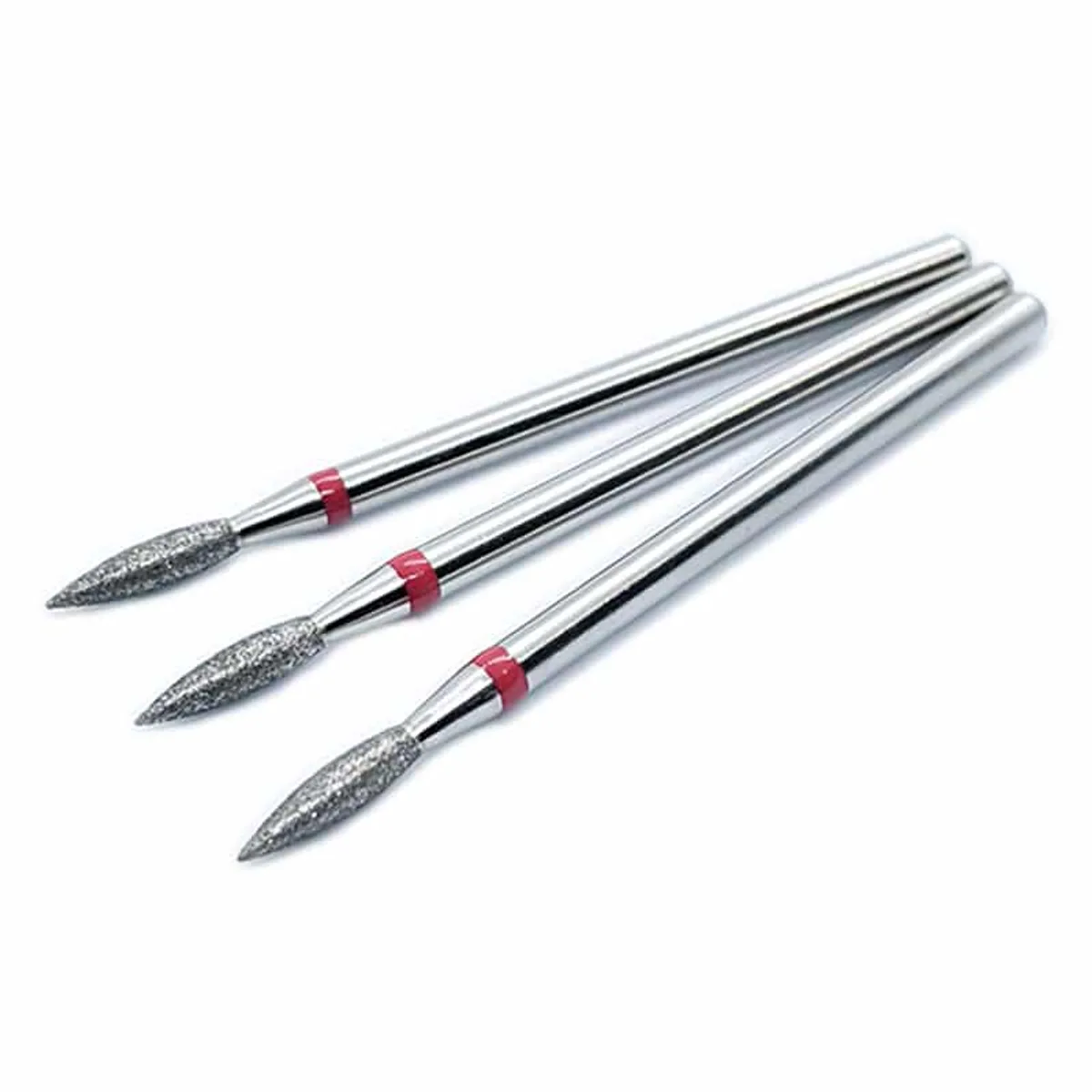
If you have ever looked at professional efile bits and wondered what the colour ring is actually telling you, you are not alone. One of the most common questions nail techs ask is what grit colour means on efile bits and whether red, blue, green, or black automatically tells you exactly how the bit will behave.
The short answer is that the colour ring usually gives you a quick guide to grit level, but it does not tell you everything on its own. Shape, material, size, and intended use still matter just as much.
That is why the safest way to use colour coding is as a general reference, not as the only reason to choose a bit.
What does grit colour mean on efile bits?
In simple terms, the colour ring on an efile bit is usually there to show how fine or how aggressive the grit is.
As a general rule:
- yellow usually means very fine
- red usually means fine
- blue usually means medium
- green usually means coarse
- black usually means extra coarse
The finer the grit, the gentler and more controlled the bit usually feels. The coarser the grit, the faster and more aggressively it usually removes product or works across the surface.
This is why grit colour matters so much. A flame bit with a fine red grit and a carbide removal bit with a coarse green ring are not even meant for the same stage of the service.
Is grit colour exactly the same on every efile bit?
Not always.
This is one of the most important things to understand. Colour coding is widely used, but there can still be variation between manufacturers and between different bit materials.
That means red is usually fine and blue is usually medium, but you should not assume colour alone tells you everything without checking the product description and intended use.
The safest approach is:
- use colour as a quick reference
- check the shape and material of the bit
- match the bit to the service stage
- follow the product description rather than relying on colour alone
This matters because a blue flame bit for prep work and a blue carbide bit for removal may both say blue, but they are still designed for very different jobs.
What does red grit usually mean?
Red usually means fine grit.
Fine grit is often a good choice when you want more control, a gentler working feel, and a bit that suits delicate prep or careful refinement rather than aggressive removal.
In practical salon work, red grit is commonly chosen for:
- detailed cuticle prep
- sidewall work
- finishing loose non-living tissue
- controlled refining rather than fast bulk removal
You can see that in products such as the Flame E File Nail Drill Bit, the Ball E File Nail Drill Bit Size 5.0mm Red, and the Cone E File Nail Drill Bit Size 1.4mm Red.
Red grit can also appear on some removal-focused bits when a technician wants a smoother and more controlled finish rather than the fastest take-down. A good example is the Left Handed Carbide Bit Red.
What does blue grit usually mean?
Blue usually means medium grit.
Medium grit sits in the middle. It is often chosen when a nail tech wants more working speed than a fine bit gives, but still wants a controlled and versatile feel.
Blue grit is common in both manicure prep and removal categories, depending on the shape and material.
For prep work, examples include the Blue Flame E File Nail Drill Bit, the Flame E File Nail Drill Bit Size 2.3mm - Blue, and the Rounded Cone E File Nail Drill Bit Size 1.8mm - Blue.
For removal work, a medium blue carbide can feel like a useful balance between control and efficiency. You can see that in the Left Handed Carbide Bit Blue.
If you are not sure where to start, blue is often the grit people choose when they want something more versatile than very fine red but not as aggressive as green.
What does green grit usually mean?
Green usually means coarse grit.
Coarse grit is more commonly associated with removal and bulk reduction rather than delicate prep work. This is the type of grit many techs reach for when they need more efficient product removal on gel, hard gel, polygel, or acrylic.
Green grit is usually better suited to:
- bulk product reduction
- faster enhancement removal
- reshaping thicker material
- reducing length on enhancements
That is why green is much more common on carbide removal bits than on manicure prep bits.
Examples include the Left Handed Carbide Bit Green and the Left Handed Carbide E file nail drill bit green for gel, acrylic removal - Green.
Green grit is useful, but it should not be treated as a default. If you use a coarse bit where a fine prep bit is really needed, the service becomes harder to control, not easier.
What about yellow and black grit?
Yellow usually means very fine, while black usually means extra coarse.
These are often seen less often than red and blue in everyday prep work, but they still matter.
Very fine yellow grit is generally associated with highly delicate refining and a softer feel. Extra coarse black grit is usually reserved for heavier removal work where speed matters more and the technician already knows exactly why that level of aggression is needed.
In some ranges, you may also see intermediate or mixed colour references, such as green-yellow, which can signal a grit that sits between categories rather than behaving like a completely separate system. One example in our range is the Left Handed Carbide Green-Yellow.
The important point is that the colour should help you compare grit levels, but it should still be interpreted in context.
How should you choose the right grit colour?
The easiest way to choose grit colour is to start with the job you need the bit to do.
If you are doing cuticle prep or detailed manicure work, finer grit is usually the safer place to start. That is why red and some blue diamond bits are so popular for flame, ball, and cone shapes.
If you are doing product removal, medium to coarse carbide grit often makes more sense, depending on how much product you need to remove and how controlled or aggressive you want the cut to feel.
A practical way to think about it is:
- choose finer grit for prep, detail, and controlled refinement
- choose medium grit for balanced versatility
- choose coarse grit for faster bulk removal when appropriate
- choose extra coarse only when you genuinely need it and know why
If you want a broader overview of how shape and material also affect performance, our guides on E-File Bits Explained and Diamond, Carbide or Ceramic? Choosing the Right E-File Bits Material are the best next reads.
Why colour should never be your only guide
One of the biggest mistakes is trying to choose a bit based only on the ring colour.
Colour helps, but it does not replace:
- material
- shape
- size
- service stage
- technique
A red flame bit, a red ball bit, and a red carbide bit do not all do the same job just because they share the same colour ring. The colour only tells you about grit level in general terms. It does not tell you whether the bit is meant for prep, removal, or finishing.
That is why experienced nail techs look at the whole bit, not just the ring.
Final thoughts
Grit colour on efile bits is there to give you a quick reference, not a complete answer.
In most cases, red means fine, blue means medium, green means coarse, yellow means very fine, and black means extra coarse. But the right bit still depends on the shape, the material, and what stage of the service you are performing.
If you want better control over your bit choices, think about the job first and the colour second. That approach is much more reliable than trying to memorise colour alone.
If you want to compare different grit colours in practice, start with a fine Flame E File Nail Drill Bit, a medium Blue Flame E File Nail Drill Bit, and a removal-focused Left Handed Carbide Bit Green to see how much grit changes the feel of the service.