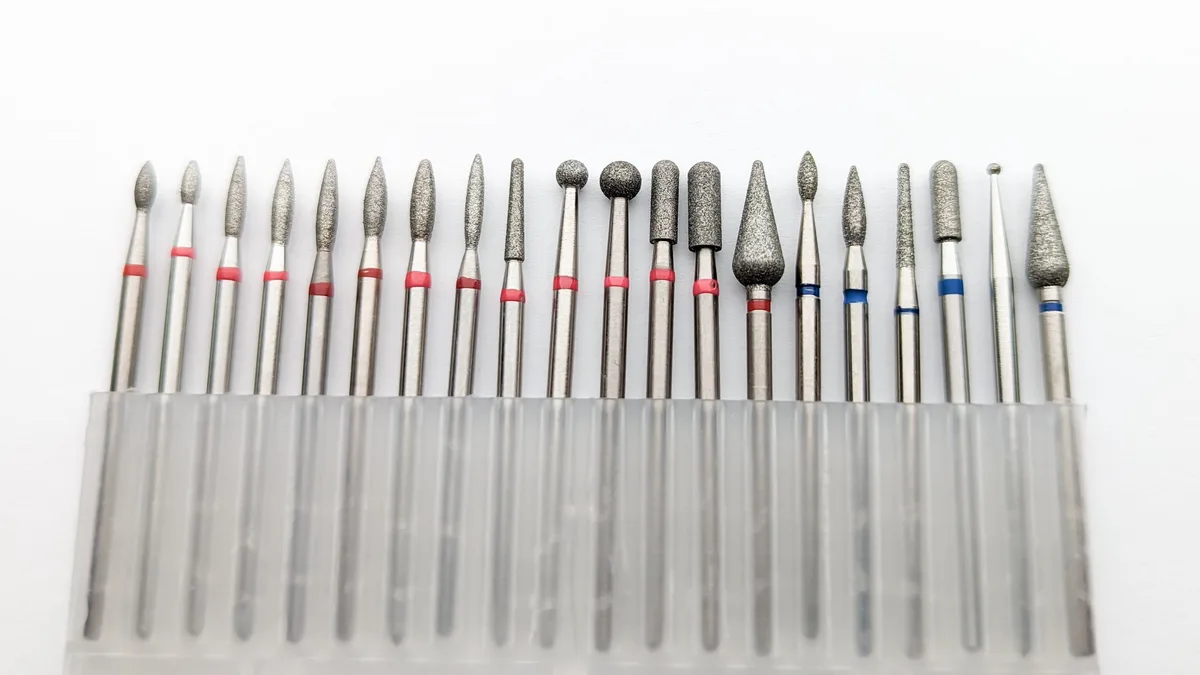
Nail drill bits can look similar at first, but each shape and material has a different purpose. Choosing the right bit is not only about what fits your e-file handpiece. It is about matching the bit to the service stage, the product you are working on, and the amount of control you need.
For professional nail techs, the most useful way to understand nail drill bits is to group them by material, shape, and job. A diamond flame bit for cuticle prep is not doing the same work as a carbide barrel bit for product removal, even though both are e-file bits.
This guide explains the main nail drill bits and their uses in a practical way.
Diamond nail drill bits
Diamond nail drill bits are usually used for detailed manicure prep and controlled work around the cuticle area. They are designed for surface refinement, not heavy product removal.
Diamond bits are commonly used for:
- cuticle area preparation
- sidewall cleaning
- detailed work around the nail fold
- refining non-living tissue
- controlled natural nail prep when the correct grit is used
Popular diamond shapes include flame, ball, cone, rounded cone, cylinder, and drop bits. If your search is focused on diamond drill bit nails, diamond file for nails, or cuticle e file bits, this is the group you are usually looking at.
You can browse our Diamond Bits category or start with a common shape like the Flame E File Nail Drill Bit.
Carbide nail drill bits
Carbide nail drill bits are made for removal and bulk reduction. They cut through product more efficiently than diamond bits, which makes them useful for gel, hard gel, polygel, and acrylic work.
Carbide bits are commonly used for:
- removing gel polish
- reducing hard gel or acrylic bulk
- shortening product
- refining enhancement material
- rebalancing and infill work
This is why searches like carbide nail drill bits, acrylic nail drill bits, drill bit to take off acrylic nails, and e file bit for removing gel polish usually belong to carbide content.
For removal work, see our Carbide Bits category or the Carbide E File Nail Drill.
Flame bits
Flame bits are one of the most popular shapes for manicure prep. The tapered shape helps reach around the cuticle area and sidewalls with more precision than a wider bit.
Flame bits are commonly used for:
- lifting and refining the cuticle area
- cleaning sidewalls
- working near the sinus area
- detailed Russian manicure prep
If you are asking what is a flame bit for nails, the simple answer is that it is mainly a prep and detailing bit, usually in diamond material.
Examples include the Flame E File Nail Drill Bit, Flame E File Nail Drill Bit Size 1.8mm, and Blue Flame E File Nail Drill Bit.
Ball bits
Ball bits are usually used after the cuticle area has already been prepared. Their rounded head helps finish and tidy the cuticle zone without the pointed feel of a flame or cone shape.
Ball bits are commonly used for:
- removing loosened non-living tissue
- finishing the cuticle area
- smoothing around sidewalls
- precise detail work with smaller sizes
Smaller sizes, such as 1.4mm, are useful when the work needs more control. Larger ball bits can feel more stable for broader finishing.
Examples include the Ball E File Nail Drill Bit Size 1.4mm and Ball E File Nail Drill Bit Size 3.1mm.
Cone and rounded cone bits
Cone nail drill bits are used when a tech wants a narrow, controlled shape for sidewall work, cuticle-area detailing, or careful surface refinement. Rounded cone bits feel slightly softer in profile because the tip is less pointed.
Cone bits are commonly used for:
- controlled sidewall work
- cuticle-area detailing
- precise manicure prep
- reaching smaller areas without using a wide bit
For this shape, see the Cone E File Nail Drill Bit and Rounded Cone E File Nail Drill Bit.
Barrel bits
Barrel bits have a wider contact area. In carbide, they are often used for product removal and surface reduction. In diamond, they can be useful for controlled surface work depending on grit and technique.
Barrel bits are commonly used for:
- product reduction
- surface refinement
- shaping enhancement material
- smoothing larger working areas
If you are looking for a barrel bit nail drill or barrel drill bit for removal, carbide is usually the material to compare first. A good example is the Barrel Carbide E File Nail Drill Bit.
Polishing bits
Polishing bits are not designed for aggressive removal. They are used for finishing, smoothing, and refining the surface after the main prep or removal stage.
Polishing bits are commonly used for:
- smoothing the final surface
- finishing manicure or pedicure work
- gentle refinement
- preparing a cleaner final look
You can compare options in our Polishing Bits category, including the Polishing E File Nail Drill Bit and Silicone Polishing E File Drill Bit Green Medium.
A simple way to choose the right nail drill bit
Start with the service, then choose the bit:
- For cuticle prep, look at diamond flame, ball, cone, and rounded cone bits.
- For gel or acrylic removal, look at carbide bits.
- For final smoothing, look at polishing bits.
- For pedicure work, choose bits and tools that match the area being treated.
This is a better approach than buying a random nail drill bit set and trying to use every bit for every task.
Final thoughts
The best nail drill bit is the one that matches the job. Diamond bits are usually the main choice for prep and detail work. Carbide bits are used for product removal. Polishing bits are for finishing.
If you are building a professional kit, start with the core shapes you will use most often: flame, ball, cone or rounded cone, carbide removal bit, and polishing bit. You can browse the full efileBits shop or compare our E File Bits collection to build a practical working set.